cutcutcodec.core.signal.window
Window a signal to control gibbs effects.
The optimal dpss window is implemented here, but it is not very stable computationally. All functions are based on the Kaiser window, which is a good compromise between stability and optimality.
Functions
|
Empirical estimation based on regression. |
|
Empirical estimation based on regression. |
|
Inverse of the empirical estimation based on regression. |
|
Inverse of the empirical estimation based on regression. |
|
Compute the Discrete Prolate Spheroidal Sequences (DPSS). |
|
For each beta parameter, associate the frequency properties. |
|
Compute the Kaiser–Bessel window. |
Details
- cutcutcodec.core.signal.window.alpha_to_att(alpha: Real) float[source]
Empirical estimation based on regression.
The fitted model is \(\eta = a*\alpha^2 + b*\alpha + c + d*\tanh(e*\alpha)\).
This function is strictly increasing.
Bijection of
att_to_alpha().Examples
>>> import torch
>>> from cutcutcodec.core.signal.window import alpha_to_att, find_win_law
>>> alphas, atts, _ = find_win_law()
>>> pred = [alpha_to_att(a) for a in alphas.tolist()]
>>> # import matplotlib.pyplot as plt
>>> # _ = plt.plot(alphas.numpy(force=True), atts.numpy(force=True))
>>> # _ = plt.plot(alphas.numpy(force=True), pred)
>>> # plt.show()
>>>
- cutcutcodec.core.signal.window.alpha_to_band(alpha: Real) float[source]
Empirical estimation based on regression.
The fitted model is \(band = a*\alpha^2 + b*\alpha + c + d*tanh(e*\alpha)\).
This function is strictly increasing.
Bijection of
band_to_alpha().Examples
>>> import torch
>>> from cutcutcodec.core.signal.window import alpha_to_band, find_win_law
>>> alphas, _, bands = find_win_law()
>>> pred = [alpha_to_band(a) for a in alphas.tolist()]
>>> # import matplotlib.pyplot as plt
>>> # _ = plt.plot(alphas.numpy(force=True), bands.numpy(force=True))
>>> # _ = plt.plot(alphas.numpy(force=True), pred)
>>> # plt.show()
>>>
- cutcutcodec.core.signal.window.att_to_alpha(att: Real) float[source]
Inverse of the empirical estimation based on regression.
Bijection of
alpha_to_att().As there is no closed form for this function, it is approximated using the tangent method.
Examples
>>> from cutcutcodec.core.signal.window import alpha_to_att, att_to_alpha
>>> round(alpha_to_att(att_to_alpha(20.0)), 6)
20.0
>>> round(alpha_to_att(att_to_alpha(40.0)), 6)
40.0
>>> round(alpha_to_att(att_to_alpha(80.0)), 6)
80.0
>>> round(alpha_to_att(att_to_alpha(120.0)), 6)
120.0
>>> round(alpha_to_att(att_to_alpha(160.0)), 6)
160.0
>>>
- cutcutcodec.core.signal.window.band_to_alpha(band: Real) float[source]
Inverse of the empirical estimation based on regression.
Bijection of
alpha_to_band().As there is no closed form for this function, it is approximated using the tangent method.
Examples
>>> from cutcutcodec.core.signal.window import alpha_to_band, band_to_alpha
>>> round(alpha_to_band(band_to_alpha(0.9)), 6)
0.9
>>> round(alpha_to_band(band_to_alpha(1.8)), 6)
1.8
>>> round(alpha_to_band(band_to_alpha(3.4)), 6)
3.4
>>> round(alpha_to_band(band_to_alpha(4.9)), 6)
4.9
>>> round(alpha_to_band(band_to_alpha(6.4)), 6)
6.4
>>>
- cutcutcodec.core.signal.window.dpss(nb_samples: Integral, alpha: Real, dtype=torch.float64) Tensor[source]
Compute the Discrete Prolate Spheroidal Sequences (DPSS).
It is similar to the scipy function
scipy.signal.windows.dpss.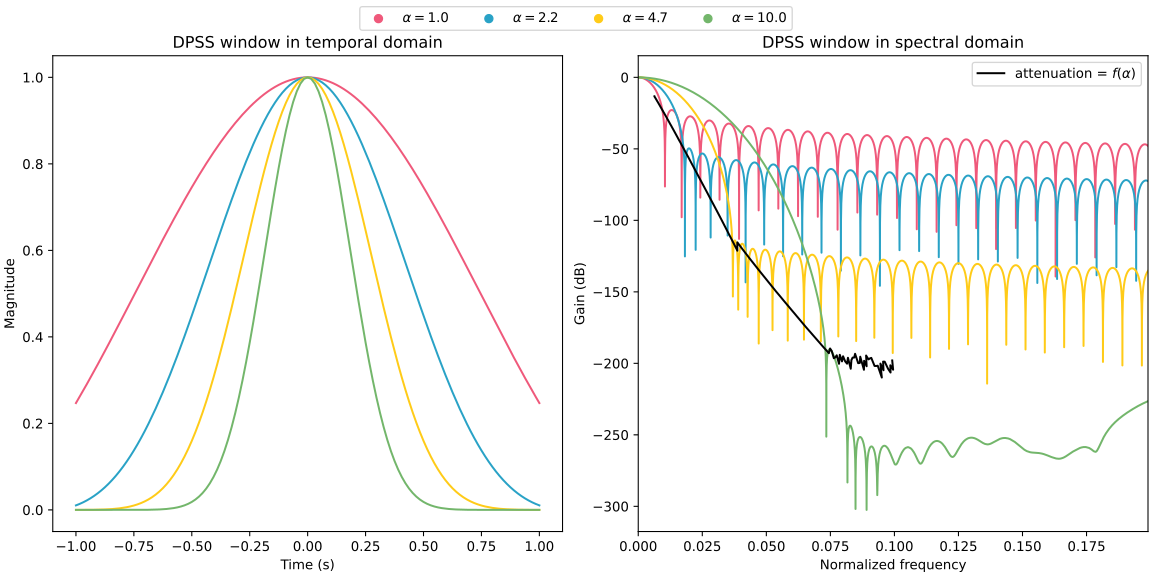
Parameters
- nb_samplesint
The window size, it has to be >= 3.
- alphafloat
Standardized half bandwidth.
- dtypetorch.dtype, default=float64
The data type of the window samples: torch.float64 or torch.float32.
Returns
- windowtorch.Tensor
The 1d symetric window, normalized with the maximum value at 1.
Examples
>>> import torch
>>> from cutcutcodec.core.signal.window import dpss
>>> dpss(1024, 2.0)
tensor([0.0158, 0.0163, 0.0169,  ..., 0.0169, 0.0163, 0.0158],
       dtype=torch.float64)
>>>
>>> # comparison with kaiser
>>> alpha, nbr = 5.0, 129
>>> win_dpss = dpss(nbr, alpha)
>>> win_kaiser = torch.kaiser_window(
...     nbr, periodic=False, beta=alpha*torch.pi, dtype=torch.float64
... )
>>> gain_dpss = 20*torch.log10(abs(torch.fft.rfft(win_dpss, 100000)))
>>> gain_dpss -= torch.max(gain_dpss)
>>> gain_kaiser = 20*torch.log10(abs(torch.fft.rfft(win_kaiser, 100000)))
>>> gain_kaiser -= torch.max(gain_kaiser)
>>>
>>> # import matplotlib.pyplot as plt
>>> # fig, (ax1, ax2) = plt.subplots(2)
>>> # _ = ax1.plot(win_dpss, label="dpss")
>>> # _ = ax1.plot(win_kaiser, label="kaiser")
>>> # _ = ax1.legend()
>>> # _ = ax2.plot(torch.linspace(0, 0.5, 50001), gain_dpss, label="dpss")
>>> # _ = ax2.plot(torch.linspace(0, 0.5, 50001), gain_kaiser, label="kaiser")
>>> # _ = ax2.axvline(x=alpha/nbr)
>>> # _ = ax2.legend()
>>> # plt.show()
>>>
- cutcutcodec.core.signal.window.find_win_law(nb_samples: Integral = 129, nb_alphas: Integral = 1000, alpha_min: Real = 0.001, alpha_max: Real = 15.0, win: str = 'kaiser') tuple[Tensor, Tensor, Tensor][source]
For each beta parameter, associate the frequency properties.
Parameters
- nb_samplesint, default=129
The window size, it has to be >= 3.
- nb_alphasint, default=1000
The number of alpha points.
- alpha_minfloat, default=ALPHA_MIN
The minimal inclusive alpha value.
- alpha_maxfloat, default=15.0
The maximal inclusive alpha value.
- winstr, default=”kaiser”
The windows type, “kaiser” or “dpss”
Returns
- alphastorch.Tensor
The apha values.
- attstorch.Tensor
The real positive attenuation of the secondaries lobs in dB.
- bandstorch.Tensor
The normalised size of the main lob.
Examples
>>> import torch
>>> from cutcutcodec.core.signal.window import find_win_law
>>> alphas, atts, bands = find_win_law()
>>>
>>> # import matplotlib.pyplot as plt
>>> # _ = plt.plot(alphas.numpy(force=True), atts.numpy(force=True), label="attenuation")
>>> # _ = plt.plot(alphas.numpy(force=True), bands.numpy(force=True), label="band")
>>> # _ = plt.legend()
>>> # plt.show()
>>>
- cutcutcodec.core.signal.window.kaiser(nb_samples: Integral, alpha: Real, dtype=torch.float64) Tensor[source]
Compute the Kaiser–Bessel window.
It is an approximation of
cutcutcodec.core.signal.window.dpss().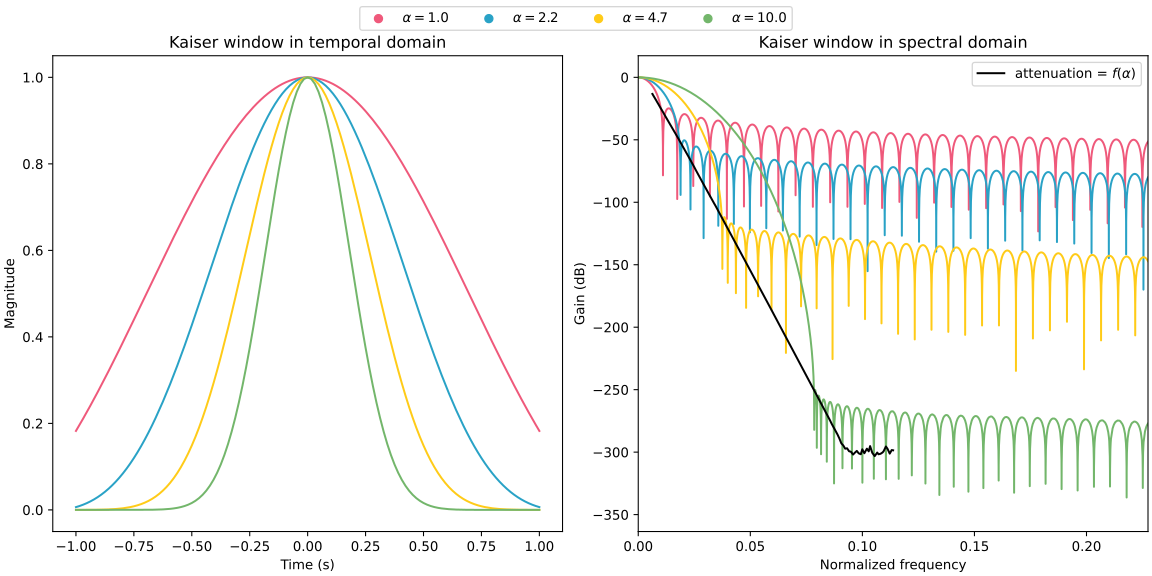
Parameters
- nb_samplesint
The window size, it has to be >= 3.
- alphafloat
Standardized half bandwidth.
- dtypetorch.dtype, default=float64
The data type of the window samples: torch.float64 or torch.float32.
Returns
- windowtorch.Tensor
The 1d symetric window, normalized with the maximum value at 1.